
The Evolution of the Fashion Buyer Role and Job Market in the Digital Era
The role of the fashion buyer is undergoing a profound transformation. Once centred primarily on product selection and trend intuition, the position is now increasingly strategic, data-driven, and closely connected to digital commerce. At the same time, the job market for fashion buyers is evolving, with fewer traditional roles but growing demand for professionals who combine product expertise with analytical and digital skills.
This article explores how the fashion buyer role is changing, how the job market is evolving, and where professionals can find new career opportunities.
- The Evolution of the Fashion Buyer Role and Job Market in the Digital Era
- How the role of the fashion buyer is evolving
- Integration with technology and AI tools
- From product selection to assortment strategy
- Customer-centric and omnichannel approach
- Increased collaboration across departments
- Faster product cycles and agile buying models
- Sustainability and responsible sourcing
- How the job market for fashion buyers is evolving
- Growing demand for hybrid digital profiles
- Polarisation between luxury and mid-market segments
- Entry-level roles becoming more competitive
- New career paths related to buying
- Where to find fashion buyer job opportunities online
- Key skills for the future fashion buyer
- Conclusion
- Best websites for fashion buyer jobs
- Overview of the fashion buyer career path
How the role of the fashion buyer is evolving
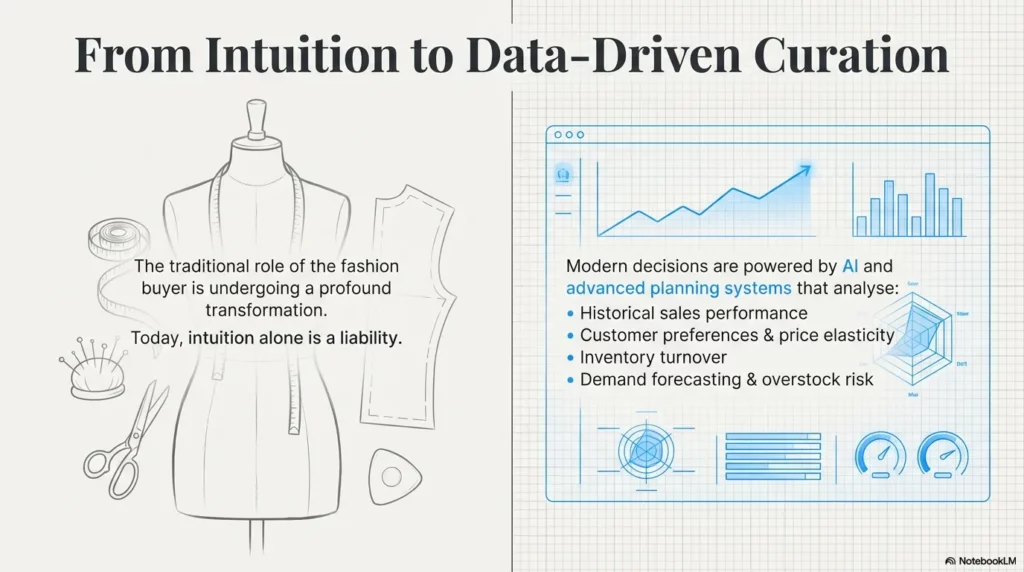
From intuition to data-driven decision making
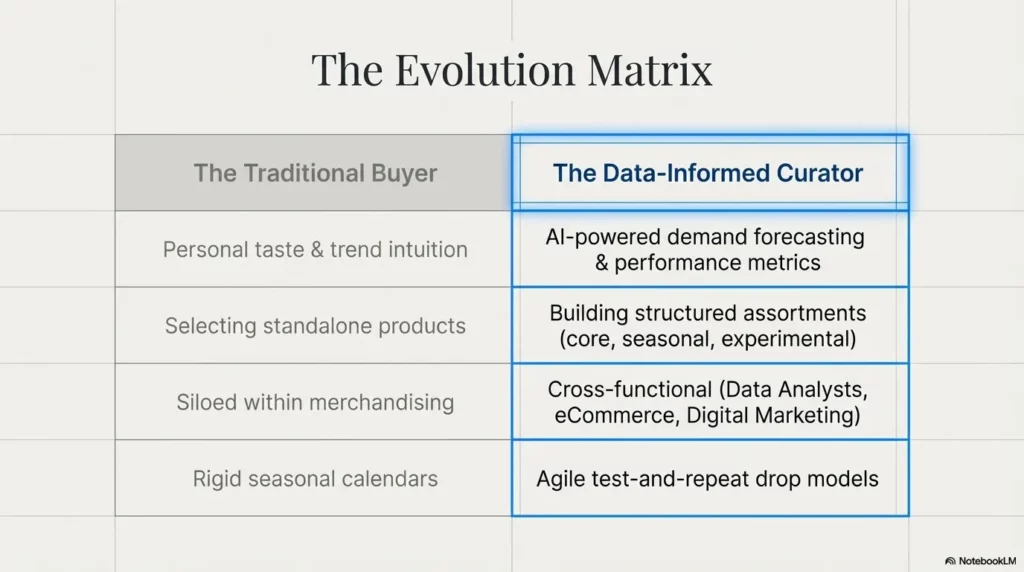
Traditionally, fashion buyers relied heavily on personal taste, trend forecasting, and relationships with brands. Today, decisions are increasingly supported by data analytics, artificial intelligence, and performance metrics.
Buyers now work with tools that analyse:
- historical sales performance
- customer preferences
- price elasticity
- inventory turnover
- demand forecasting
The modern buyer is becoming a “data-informed curator”, combining creative sensitivity with analytical capabilities.
Integration with technology and AI tools
Digital transformation is reshaping the way buying decisions are made. AI-powered tools help predict demand, optimise assortments, and reduce overstock risk. Many retailers now use advanced planning systems that simulate product performance before committing to orders.
As a result, buyers increasingly collaborate with:
- data analysts
- merchandising teams
- eCommerce managers
- digital marketing specialists
The role is becoming more strategic and less operational.
From product selection to assortment strategy
Buying is no longer simply about selecting products. Today’s buyers must balance:
- profitability and margins
- brand positioning
- inventory risk
- customer experience
- pricing strategy
Buyers are increasingly responsible for building structured assortments that include:
- core products
- seasonal trends
- experimental items
- exclusive collaborations
In many organisations, buyers act as category managers responsible for the overall commercial performance of product lines.
Customer-centric and omnichannel approach
The growth of eCommerce has significantly influenced buying decisions. Buyers must understand how customers interact with brands across multiple channels:
- online store
- marketplaces
- physical retail
- mobile commerce
- social commerce
Consumer data plays an increasingly important role in determining product selection, quantities, and timing of product launches.
Buying decisions are now closely aligned with CRM strategies and customer lifetime value.
Increased collaboration across departments
The buyer role is no longer isolated within merchandising teams. Today’s buyers collaborate closely with:
- digital marketing teams
- eCommerce managers
- supply chain departments
- brand and creative teams
Product selection is increasingly influenced by storytelling, campaigns, and digital positioning.
Faster product cycles and agile buying models
Fashion companies are reducing time-to-market and introducing more frequent product drops. This requires buyers to react faster to market signals and adapt assortment strategies more dynamically.
Test-and-repeat models allow brands to launch smaller product quantities and scale successful items quickly.
Sustainability and responsible sourcing
Sustainability remains an important factor in buying decisions. Buyers are increasingly involved in selecting suppliers based on:
- ethical production practices
- material sourcing
- environmental impact
- transparency
Although cost pressures sometimes limit the speed of change, sustainability is expected to remain a long-term priority in buying strategies.
How the job market for fashion buyers is evolving
Fewer traditional roles, higher skill requirements
The number of traditional fashion buyer roles is gradually declining as retailers optimise organisational structures and adopt automation tools.
Companies are increasingly looking for professionals who combine:
- commercial awareness
- analytical skills
- digital understanding
- financial planning capabilities
The role is evolving into a hybrid position between buyer, merchandiser, and business analyst.
Growing demand for hybrid digital profiles
Fashion companies increasingly seek professionals with experience in:
- eCommerce merchandising
- data analysis
- assortment optimisation
- pricing strategy
- omnichannel retail
- demand forecasting tools
Professionals who understand both product and digital performance are particularly valued.
Polarisation between luxury and mid-market segments
Opportunities for buyers vary significantly depending on market segment.
Luxury and premium brands continue to invest in differentiated assortments and exclusive collaborations, maintaining demand for experienced buyers.
Mid-market retailers are more exposed to margin pressure and competition from online platforms, which has led to restructuring and more selective hiring.
Entry-level roles becoming more competitive
Junior roles such as assistant buyer positions still exist but often require:
- internships or practical experience
- strong Excel and analytical skills
- understanding of eCommerce metrics
- familiarity with digital tools
Graduates entering the profession are expected to have a more technical skill set than in the past.
New career paths related to buying
As the profession evolves, new roles are emerging that are closely related to buying:
- Merchandise planner
- Category manager
- eCommerce merchandiser
- Product data analyst
- Demand planner
- Marketplace manager
These roles often offer strong career opportunities for professionals with analytical and digital competencies.
Where to find fashion buyer job opportunities online
Specialist fashion job platforms
Some job boards focus specifically on fashion and luxury roles:
- FashionUnited
- BoF Careers
- Drapers Jobs
- Fashion Workie
These platforms often include positions in buying, merchandising, and product management across international markets.
General job platforms
Large job platforms provide a high volume of listings:
- LinkedIn Jobs
- Indeed
- Reed
- Totaljobs
- Glassdoor
These platforms allow users to set alerts and track market trends in hiring demand.
Recruitment agencies specialised in fashion and luxury
Recruitment agencies often manage mid-level and senior buyer searches:
- Zachary Daniels
- Luxury Recruit
- Four Seasons Recruitment
- Elite Associates
Working with specialised recruiters can increase access to confidential opportunities.
Key skills for the future fashion buyer
Professionals who want to succeed in the evolving job market should develop skills in:
- data interpretation
- Excel and analytics tools
- assortment planning
- pricing strategy
- digital merchandising
- omnichannel retail strategy
- supplier negotiation
- trend analysis
The combination of creative and analytical capabilities is becoming essential.
Conclusion
The role of the fashion buyer is becoming more strategic, analytical, and digitally integrated. While the number of traditional roles may decline, new opportunities are emerging for professionals who can combine product expertise with data-driven decision-making.
Understanding how digital commerce influences buying decisions is now a key success factor. As fashion companies continue to invest in omnichannel strategies, the buyer role will increasingly sit at the intersection of product, customer experience, and business performance.
For professionals working in fashion eCommerce and digital transformation, this evolution creates new career opportunities and highlights the growing importance of cross-functional skills.
Best websites for fashion buyer jobs
Specialist fashion job boards
These are often the most relevant because they focus on fashion, luxury and retail roles.
1. FashionUnited
- Strong European coverage
- Roles in buying, merchandising and product management
- Includes brands like NEXT, White Stuff, etc.
- ➜ Browse fashion buyer jobs
2. BoF Careers
- High-quality roles in luxury and premium brands
- Good for senior buyer positions
- Often includes international roles
3. Drapers Jobs
- Focus on UK fashion retail and brands
- Useful for buying and merchandising roles
4. Fashion Workie
- Good for internships and entry-level buyer roles
- Increasing number of digital commerce roles
General job platforms (large volume of roles)
5. LinkedIn
- Very strong for fashion buyer roles in UK and Europe
- Example: 190+ fashion buyer jobs listed in the UK
- Useful for networking with hiring managers
6. Indeed
- Large database of fashion buying roles
- Includes hybrid roles like buyer + eCommerce manager
7. Reed
- Around 100+ buyer-related openings depending on filters
8. Totaljobs
9. Glassdoor
Major UK job sites like Indeed, LinkedIn and Reed are considered among the most effective platforms due to their large number of listings and filtering tools
Recruitment agencies specialising in fashion & retail
Useful especially for mid-senior roles:
- Zachary Daniels
- Luxury Recruit
- Four Seasons Recruitment
- Elite Associates
Recruiters often manage confidential buyer searches.
Most requested skills for fashion buyer jobs
1. Analytical & data skills (increasingly critical)
Modern fashion buyers are expected to interpret performance data and make financially sound decisions.
Most requested capabilities include:
- sales analysis
- demand forecasting
- margin optimisation
- budgeting and cost control
- assortment performance analysis
- KPI monitoring
Analytical and numerical ability is consistently listed as a core competency because buyers must evaluate profitability and forecast demand trends.
Understanding ratios, pricing structures, and margins is essential for commercial decision-making.
2. Commercial & strategic thinking
Employers increasingly seek buyers who understand the broader business impact of product decisions.
Key strategic skills include:
- pricing strategy
- category management
- assortment planning
- product lifecycle management
- competitor benchmarking
- profit optimisation
Buyers are responsible for ensuring product ranges meet customer demand while achieving business goals.
Strong business acumen and decision-making skills are frequently highlighted in job descriptions.
3. Trend forecasting & product sensitivity
Creative judgment remains essential in fashion buying roles.
Frequently requested capabilities:
- trend forecasting
- product selection
- understanding consumer preferences
- competitor analysis
- brand positioning awareness
Buyers must interpret fashion trends and align product choices with target customer expectations.
Trend research remains a core responsibility across fashion buying careers.
4. Negotiation & supplier management
Relationship management skills remain highly valued.
Typical requirements:
- vendor negotiation
- supplier relationship management
- cost negotiation
- partnership development
- sourcing strategy
Vendor relations and negotiation skills are among the most frequently mentioned competencies in buyer resumes.
Strong interpersonal communication skills are necessary for collaboration with suppliers and internal stakeholders.
5. Digital & technical skills (fast-growing requirement)
The digitalisation of retail is changing skill requirements.
Increasingly requested technical skills include:
- Excel and data tools
- merchandising software
- ERP / PLM systems
- eCommerce analytics
- inventory management software
- omnichannel performance analysis
Proficiency with retail systems and inventory management tools is often required in job descriptions.
Overview of the fashion buyer career path
The career progression traditionally follows a structured hierarchy, starting with administrative support roles and moving toward strategic leadership positions.
However, today the path is becoming more flexible, with increasing crossover into merchandising, eCommerce, and data-driven roles.
What the typical career progression in fashion buying looks like
1. Entry level roles
Buying Assistant / Buying Admin Assistant
Typical experience: 0–2 years
Responsibilities:
- managing product data and samples
- preparing reports and sales analysis
- supporting supplier communication
- coordinating orders and deliveries
- updating assortment information in systems
Skills developed:
- Excel and reporting
- organisation and time management
- basic retail KPIs
- understanding product lifecycle
This role provides exposure to the operational side of buying.
Assistant Buyer
Typical experience: 1–3 years
Responsibilities:
- analysing product performance
- supporting assortment planning
- supplier coordination
- preparing buying meetings
- trend research
Skills developed:
- data interpretation
- trend analysis
- negotiation basics
- pricing structure understanding
Assistant buyers begin contributing to product selection decisions.
2. Mid-level roles
Buyer
Typical experience: 3–6 years
Responsibilities:
- selecting product ranges
- managing budgets and margins
- negotiating with suppliers
- analysing sales performance
- defining seasonal assortment strategy
Skills developed:
- commercial decision making
- forecasting
- supplier negotiation
- assortment optimisation
- category strategy
Buyers are responsible for the commercial success of product categories.
Senior Buyer
Typical experience: 5–8 years
Responsibilities:
- defining category strategy
- managing supplier relationships
- mentoring junior team members
- aligning buying with brand positioning
- improving margin performance
Skills developed:
- strategic thinking
- leadership skills
- advanced financial planning
- cross-functional collaboration
Senior buyers often manage complex or high-value product categories.
3. Leadership roles
Buying Manager / Head of Buying
Typical experience: 8–12 years
Responsibilities:
- leading buying teams
- defining company assortment strategy
- aligning product strategy with brand positioning
- managing budgets across categories
- collaborating with merchandising and marketing teams
Skills developed:
- leadership and team management
- business strategy
- financial planning
- cross-department coordination
Buying Director / Chief Merchandising Officer
Typical experience: 12+ years
Responsibilities:
- defining company-wide product strategy
- managing multiple categories
- aligning buying strategy with financial targets
- contributing to company growth strategy
- overseeing merchandising structure
These roles are highly strategic and closely connected to company leadership.
Sources
FashionUnited – retail insights and buying trends
McKinsey – The State of Fashion reports
Business of Fashion Careers – job market insights
Drapers – UK fashion retail employment trends
LinkedIn Jobs – fashion buyer job listings
Indeed – retail and fashion employment data
Luxe Talent – recruitment insights in fashion and luxury
U&I Search – hiring trends in fashion and retail